
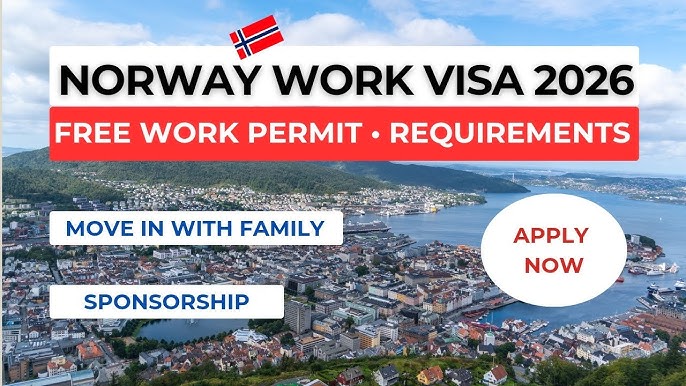
If you are planning to work in Norway in 2026, understanding the Norway work permit requirements, eligibility criteria, required documents, application process, and costs is an important first step. Norway is known for its strong economy, high employment standards, and demand for workers in several industries.
For citizens of countries outside the EU/EEA, working in Norway generally requires the appropriate residence permit for work. The specific permit you need depends on your job, qualifications, salary, employer, and other circumstances.
This guide explains how the Norway work permit process generally works in 2026, including who may qualify, what documents you may need, how to apply, potential costs, processing considerations, and what to do after arriving in Norway.
Important: Norwegian immigration rules, fees, salary requirements, and application procedures can change. Always check the latest information from the Norwegian Directorate of Immigration (UDI), the Norwegian police, and the relevant Norwegian embassy or visa application center before submitting an application.
What Is a Norway Work Permit?
People commonly use the term Norway work permit to describe permission to legally work in Norway. Technically, for many non-EU/EEA nationals, this is handled through a residence permit for work rather than a separate document simply called a “work permit.”
The type of residence permit you need depends on your circumstances.
For example, Norway has immigration routes for certain:
- Skilled workers
- Seasonal workers
- Self-employed individuals
- Workers employed by specific employers
- Other specialized employment categories
The requirements for each category can be different, so choosing the correct permit is one of the most important parts of the application.
Who Needs a Norway Work Permit in 2026?
Your nationality determines whether you need a residence permit to work in Norway.
EU/EEA citizens
Citizens covered by EU/EEA free-movement rules generally have different rights from workers coming from outside the EU/EEA.
Non-EU/EEA citizens
If you are from a country outside the EU/EEA, you will generally need an appropriate residence permit to work legally in Norway.
There are exceptions and special rules for certain situations, so applicants should check their individual circumstances with UDI before making travel or employment arrangements.
Norway Work Permit Requirements in 2026
The requirements depend on the specific work immigration category.
For a typical skilled worker residence permit, applicants generally need to satisfy conditions relating to:
- A genuine job offer
- Relevant qualifications or skills
- The nature of the position
- Salary and working conditions
- The employer
- Full-time or qualifying employment
- Compliance with Norwegian immigration rules
Some occupations may also have professional authorization requirements.
For example, regulated professions in healthcare and certain other fields can require authorization or recognition of qualifications before you can legally perform the job.
Norway Skilled Worker Residence Permit
One of the most important routes for qualified foreign workers is the skilled worker residence permit.
You may potentially qualify if you have the necessary qualifications and a qualifying employment offer.
Your qualifications could include:
University or college education
A relevant university or college degree may qualify you for skilled-worker status depending on the position and other requirements.
Vocational training
Applicants with recognized vocational qualifications may also qualify for certain skilled positions.
Special qualifications
In some circumstances, extensive professional experience may be considered if it is equivalent to formal qualifications under the applicable rules.
However, simply having work experience does not automatically mean that you qualify. UDI determines eligibility based on the applicable requirements and evidence.
Norway Work Permit Job Offer Requirements
Having a genuine employment offer is generally one of the most important parts of the process.
The position should satisfy the requirements of the relevant residence-permit category.
The employment offer should clearly establish information such as:
- Employer identity
- Job title
- Job responsibilities
- Salary
- Working hours
- Employment period
- Workplace
- Other relevant employment conditions
Norwegian authorities can assess whether the employment terms comply with applicable requirements.
Do not rely on an informal promise of employment. Applicants should verify that the employer and job offer are genuine before providing sensitive documents or paying recruitment-related charges.
Required Documents for a Norway Work Permit
The exact document checklist depends on your permit type and nationality.
However, applicants may commonly need documents such as:
- Valid passport
- Completed application
- Passport photographs where applicable
- Employment contract or job-offer documentation
- Educational certificates
- Vocational qualifications
- Evidence of professional experience where relevant
- CV or résumé
- Proof of accommodation where required
- Documentation relating to professional authorization, if applicable
- Additional documents requested by UDI or the relevant authorities
Documents issued outside Norway may need translation or other formalities depending on the circumstances.
Always use the personalized document checklist generated for your application rather than assuming that every applicant needs exactly the same documents.
Step-by-Step Norway Work Permit Application Process
Step 1: Determine Which Permit You Need
Before applying, identify the residence permit category that matches your circumstances.
For example, you may be considering:
- Skilled worker
- Seasonal worker
- Self-employed worker
- Another employment-based route
Choosing the wrong category can create unnecessary delays or complications.
Start by checking UDI’s official requirements.
Step 2: Find a Genuine Job in Norway
For many work-based immigration routes, you need a qualifying job offer from a Norwegian employer.
You can search for vacancies through legitimate employment platforms, recruitment companies, and company career pages.
When evaluating a job offer, check:
- Company name
- Company website
- Norwegian business details
- Job description
- Salary
- Working hours
- Contract duration
- Location
- Contact information
Be cautious if a recruiter asks for unusually large payments in exchange for a guaranteed job or visa.
No legitimate recruiter can guarantee that Norwegian immigration authorities will approve your residence permit.
Step 3: Confirm That the Job Meets Immigration Requirements
A job offer by itself does not necessarily qualify you for a work residence permit.
The position must meet the requirements of the relevant immigration category.
For skilled-worker applications, authorities can consider factors such as:
- Your qualifications
- The job’s skill level
- Whether the position requires skilled qualifications
- Employment conditions
- Salary
- The employer
Review the current UDI requirements carefully before submitting your application.
Step 4: Prepare Your Documents
Collect the required documentation before starting the final application process.
Make sure:
- Your name is consistent across documents.
- Passport information is accurate.
- Educational certificates are genuine.
- Employment information matches the job offer.
- Translations are completed when required.
- Documents are clear and readable.
Never submit altered or fraudulent documents.
Providing false information can seriously affect your immigration application and future ability to enter or stay in Norway.
Step 5: Complete the Online Application
Many Norwegian immigration applications can be initiated online through the official UDI system.
You will generally need to provide information about:
- Your identity
- Nationality
- Passport
- Employment
- Employer
- Qualifications
- Previous immigration history where requested
- Contact information
Read every question carefully before submitting the form.
Save copies of your application and confirmation information.
Step 6: Pay the Applicable Application Fee
Most residence-permit applications involve an application fee, although the exact amount depends on the permit category and current regulations.
The fee can change, so do not rely on an old article or social-media post for the current amount.
Before payment, verify the fee through the official UDI website.
You may also have separate expenses for:
- Document translation
- Certification
- Travel
- Appointment services
- Transportation
- Other administrative requirements
Step 7: Attend the Required Appointment
Depending on your location and circumstances, you may need to submit documents and/or provide biometric information through the relevant Norwegian authority, police office, embassy, consulate, or application center.
Bring the required original documents and copies according to the instructions you receive.
Failure to provide required documentation can delay the application.
How Long Does a Norway Work Permit Take?
There is no universal processing time for every applicant.
Processing can depend on:
- Permit category
- Completeness of the application
- Verification requirements
- Application volume
- Applicant’s circumstances
- Employer-related information
- Whether additional documentation is requested
UDI publishes processing information that can change over time.
Therefore, check the official UDI processing-time page when preparing your application instead of relying on a fixed number of days quoted by an unofficial website.
Norway Work Permit Cost in 2026
The cost of a Norway residence permit for work depends on the application category and current fee schedule.
In addition to the government application fee, you may have other expenses, including:
- Document translation
- Certification or legalization where applicable
- Travel to an application center
- Passport-related expenses
- Accommodation during appointments
- Professional immigration assistance, if you voluntarily use it
Because government fees can change, always verify the current price directly through UDI before paying.
Avoid websites that claim that paying an additional unofficial fee will guarantee approval.
What Happens After Your Norway Work Permit Is Approved?
Once your residence permit has been approved, you should follow the instructions provided by the Norwegian authorities.
Depending on your circumstances, this can involve:
- Obtaining the appropriate entry visa if one is required for your nationality.
- Travelling to Norway according to the conditions of your permit.
- Completing registration procedures.
- Providing biometrics if required.
- Receiving your residence card.
- Beginning employment according to the conditions of your permit.
Do not assume that approval automatically gives you unlimited rights to work for any employer or in any occupation.
Your rights are determined by the specific permit you receive.
Can You Bring Your Family to Norway?
Some workers with Norwegian residence permits may be eligible to apply for family immigration for qualifying family members.
Eligibility depends on factors such as:
- Your residence status
- Your relationship to the family member
- Income requirements
- Housing or other conditions
- The family member’s circumstances
Family immigration is a separate application process, so applicants should check UDI’s current requirements rather than assuming that every work permit automatically provides family reunification.
Can You Change Jobs After Getting a Norway Work Permit?
This depends on the type of residence permit you hold.
Some work permits are connected to a particular employer or type of work. Changing your job without checking the immigration rules first can create problems.
Before changing employers:
- Check the conditions of your residence permit.
- Review current UDI rules.
- Determine whether a new application or notification is required.
- Make sure you remain legally authorized to work.
Do not assume that a residence permit automatically allows unrestricted employment.
Common Norway Work Permit Mistakes to Avoid
1. Using fake documents
Never submit forged certificates, employment contracts, bank documents, or identity documents.
2. Paying for guaranteed employment
A person promising a guaranteed Norway job or residence permit should be treated with caution.
3. Applying under the wrong category
Different residence permits have different eligibility requirements.
4. Ignoring salary requirements
Employment conditions can be an important part of work-based immigration applications.
5. Providing inconsistent information
Your CV, employment contract, passport, application, and qualifications should contain accurate information.
6. Relying on outdated information
Immigration rules and fees can change. A guide published several years ago may no longer be accurate.
7. Booking non-refundable travel too early
Wait until you understand the applicable entry requirements and have the necessary approval before making expensive travel commitments.
How to Avoid Norway Work Visa Scams
People searching for overseas employment can be targeted by fraudulent recruiters.
Warning signs include:
- Guaranteed visa approval
- Guaranteed employment without an interview
- Requests for large cash payments
- Fake government letters
- Pressure to pay immediately
- Requests to send your passport to an unknown person
- Claims of special connections with immigration officials
- Job offers with unrealistic salaries
- Requests to falsify documents
Before accepting an offer, independently verify the employer.
For immigration information, use official Norwegian government sources, particularly UDI (Norwegian Directorate of Immigration).
Tips for a Strong Norway Work Permit Application
A careful application can help reduce avoidable mistakes.
Check your eligibility first
Don’t start by paying an agent. First determine whether your job and qualifications fit an available immigration category.
Prepare documents early
Educational and professional documents can take time to obtain or translate.
Use accurate information
Never exaggerate qualifications or employment history.
Follow the official checklist
Your personalized UDI checklist is more reliable than a generic online article.
Keep records
Save copies of your application, employment contract, payment receipt, correspondence, and other important documents.
Monitor your application
Use the official channels available for checking your application status or responding to requests for additional information.
Frequently Asked Questions
Is IELTS required for a Norway work permit?
There is not one universal IELTS requirement for every Norwegian work residence permit. Language requirements can depend on the job, employer, profession, and immigration category. Check the specific requirements applicable to your application.
Can I apply for a Norway work permit without a job?
For many employment-based residence permits, having a qualifying job offer is a central requirement. Some other categories have different rules.
Can a foreign worker get a job in Norway without a degree?
Potentially, depending on the occupation and immigration category. Some skilled-worker routes recognize vocational qualifications or certain combinations of qualifications and experience, while other jobs may have different requirements.
Is a Norway work permit permanent?
A work residence permit is not necessarily permanent. The duration and renewal conditions depend on the specific permit. Some people may eventually qualify for permanent residence if they satisfy the relevant requirements.
Can I bring my spouse to Norway?
Depending on your residence status and circumstances, your spouse or other qualifying family members may be eligible for family immigration. Separate requirements apply.
How can I check official Norway work permit requirements?
The Norwegian Directorate of Immigration (UDI) is the primary official source for immigration requirements. Applicants should check UDI’s current website before applying.
Final Conclusion
Getting a Norway work permit in 2026 requires careful preparation and an understanding of the correct immigration category. For many non-EU/EEA workers, the process involves finding a qualifying Norwegian employer, confirming that the position meets the relevant requirements, preparing supporting documents, submitting an application, paying the applicable fee, and completing any required appointment or biometric procedures.
The most important thing is to use current official information. Norway’s immigration rules, application fees, processing times, and eligibility requirements can change, so applicants should verify all important details through UDI and the relevant Norwegian authorities.
Most importantly, avoid fraudulent recruiters, fake employment contracts, and anyone promising guaranteed immigration approval. A legitimate application should be based on genuine employment, accurate information, and compliance with Norwegian immigration law.
Disclaimer: This article is for general informational purposes only and does not constitute legal or immigration advice. Immigration requirements can change, and individual circumstances may affect eligibility. Always verify current requirements with the Norwegian Directorate of Immigration (UDI), the Norwegian authorities, or a qualified immigration professional before making important decisions.
