

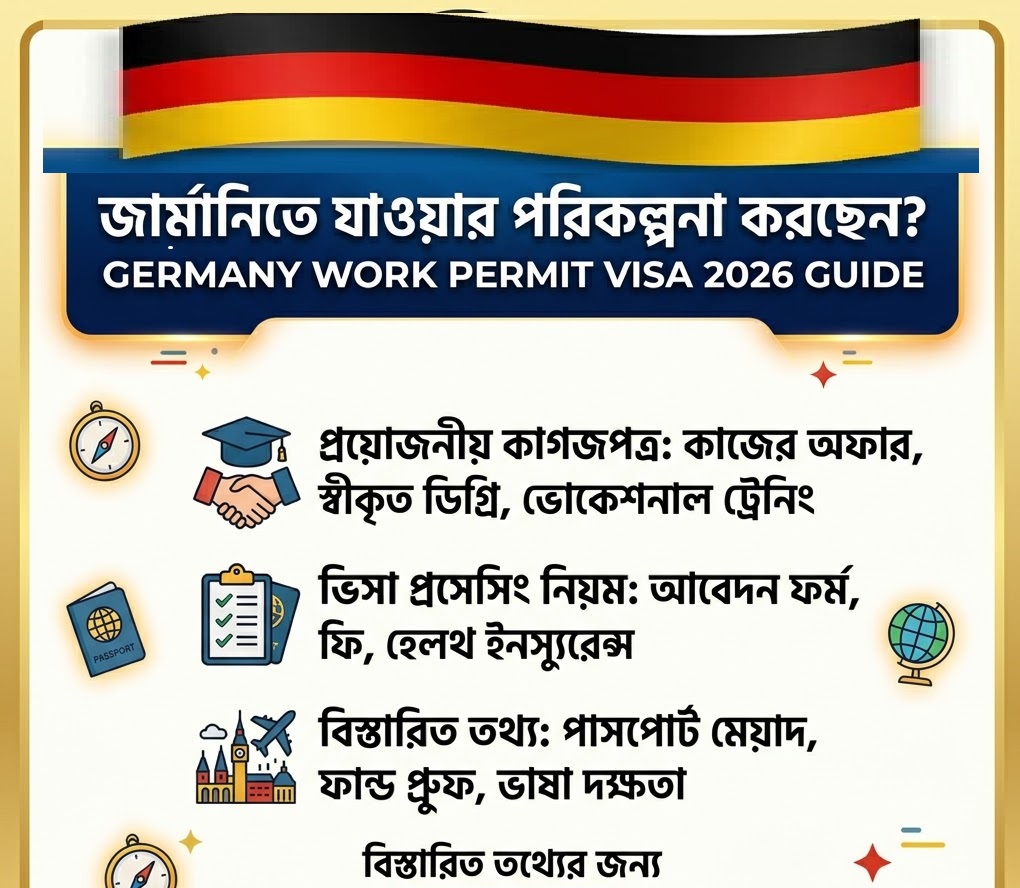
Germany remains one of Europe’s most attractive destinations for skilled international workers. Its strong economy, demand for qualified professionals, competitive salaries in many industries, and established immigration pathways make it an appealing option for people looking to build a career abroad.
If you are planning to work in Germany in 2026, understanding the Germany work permit requirements, visa process, eligibility criteria, required documents, and potential costs is essential.
For most non-EU citizens, moving to Germany for employment involves obtaining the appropriate national visa and residence permit for employment. Depending on your qualifications, job offer, salary, and profession, you may qualify for routes such as the EU Blue Card, skilled worker residence permit, or other employment-based immigration options.
This guide explains how to get a Germany work permit in 2026 and provides a step-by-step overview of the application process.
What Is a Germany Work Permit?
A Germany work permit is authorization that allows a foreign national to legally work in Germany under the conditions specified by German immigration authorities.
Germany generally uses residence permits that include permission to work rather than a separate “work permit” in the same sense used by some other countries.
The appropriate immigration route depends on factors such as:
- Your nationality
- Your academic or vocational qualification
- Whether your qualification is recognized in Germany
- Your employment contract or job offer
- Your salary
- Your occupation
- Whether your profession is regulated
- Your previous work experience
- Whether you qualify for an EU Blue Card or another residence pathway
EU, EEA, and Swiss citizens generally have significantly fewer immigration requirements because of freedom-of-movement rules. Non-EU nationals normally need the appropriate German visa and residence authorization before beginning employment.
Germany Work Visa vs. Germany Work Permit
These terms are often used interchangeably, but they are not exactly the same.
A Germany work visa is generally the entry visa that a non-EU national may need to enter Germany for employment.
A residence permit for employment is the longer-term authorization that allows the person to reside and work in Germany according to the conditions of the permit.
For many applicants, the process therefore looks like this:
Job offer → visa application → entry into Germany → residence permit → legal employment
Some people may be exempt from obtaining an entry visa depending on their nationality and circumstances, while others may have access to special routes such as the EU Blue Card or Opportunity Card.
Who Is Eligible for a Germany Work Permit in 2026?
Eligibility depends on the immigration route you are applying under. However, many employment-based applicants need to meet several basic requirements.
1. You Have a Valid Job Offer
For many work-based residence routes, applicants need a concrete employment offer or employment contract from a German employer.
The position should generally correspond to the requirements of the immigration category being used.
Your employment contract may be reviewed to determine information such as:
- Job title
- Salary
- Working hours
- Contract duration
- Employer information
- Job responsibilities
- Place of employment
2. You Have a Recognized Qualification
Skilled-worker immigration generally requires an appropriate recognized or comparable qualification.
Depending on your profession, this could include:
- University degree
- Vocational qualification
- Professional qualification
- Specialized training
Germany has procedures for determining whether certain foreign qualifications are comparable to German qualifications.
Applicants should check whether their particular qualification needs formal recognition before submitting an application.
3. Your Employment Meets the Applicable Requirements
The job must meet the requirements of the residence category you are applying for.
Some categories have specific requirements concerning salary, qualification, occupation, or other employment conditions.
The EU Blue Card, for example, is intended for highly qualified professionals and has specific salary requirements that can change over time. Applicants should verify the applicable salary threshold for the year of application directly through official German sources.
4. You Meet Any Profession-Specific Requirements
Some occupations are regulated in Germany.
Examples can include certain healthcare professions and other professions where a professional license or formal recognition is required.
If your occupation is regulated, receiving a job offer alone may not be sufficient. You may need professional recognition or authorization before you can legally work in that occupation.
5. You Meet General Visa and Residence Requirements
Depending on your situation, authorities may also consider:
- Valid passport
- Health insurance
- Financial circumstances
- Accommodation or residence information
- Criminal-record information where applicable
- Previous immigration history
- Proof of qualification
- Employment information
The exact requirements vary by residence category.
Germany Work Permit Required Documents in 2026
Preparing complete documentation can significantly reduce avoidable delays in the application process.
The exact document checklist depends on the visa category and your personal circumstances, but commonly requested documents can include the following.
1. Valid Passport
You will generally need a valid passport with sufficient validity and available pages for the visa.
Make sure your personal information is consistent across your passport, application forms, employment documents, and educational records.
2. Employment Contract or Job Offer
A signed employment contract or formal job offer from your German employer is commonly required for employment-based applications.
It should clearly show important employment details such as salary, position, employer, and working conditions.
3. Proof of Educational or Professional Qualifications
You may need to submit:
- University certificates
- Diplomas
- Academic transcripts
- Vocational certificates
- Professional licenses
- Qualification recognition documents
Documents may need to be translated or certified depending on the requirements of the relevant authority.
4. Proof of Qualification Recognition
If your immigration category requires recognition or comparability of your foreign qualification, provide the relevant documentation.
Applicants should check the official German Anerkennung information and the responsible authority for their profession.
5. Curriculum Vitae
A current CV can be required as part of the application.
Your CV should accurately describe your education, employment history, skills, and professional experience.
Avoid including information that cannot be supported by documentation.
6. Proof of Health Insurance
Health insurance is an important requirement for residence in Germany.
Applicants should make sure their insurance coverage meets the requirements applicable to their visa or residence application.
7. Proof of Accommodation or Address
Depending on the application stage and circumstances, you may be asked to provide information about where you will stay in Germany.
Requirements can differ between visa applications and residence permit procedures.
8. Visa Application Forms and Photographs
Applicants generally need the relevant application forms and biometric photographs that comply with German visa requirements.
9. Additional Supporting Documents
Depending on your situation, authorities may request additional evidence, including:
- Proof of work experience
- Language certificates
- Professional registration
- Financial documents
- Previous residence permits
- Marriage or birth certificates
- Criminal-record certificates where applicable
Do not assume that every applicant needs every document on this list. Always use the checklist provided by the responsible German mission or immigration authority for your specific case.
Step-by-Step Germany Work Permit Application Process
The following process provides a general overview for non-EU nationals.
Step 1: Determine the Right Immigration Route
Before applying, identify which German employment route fits your circumstances.
Possible options may include:
- Skilled worker residence permit
- EU Blue Card
- Other employment-based residence permits
- Opportunity Card for eligible job seekers
- Routes for specific professional categories
Choosing the correct category is important because eligibility, salary requirements, documentation, and procedures can differ.
Step 2: Check Whether Your Qualification Is Recognized
If your immigration route requires a recognized or comparable qualification, check this before submitting your visa application.
Germany provides official systems and databases that can help applicants determine the recognition status of foreign qualifications.
For regulated professions, additional professional recognition may be required.
Step 3: Find a Suitable Job in Germany
For many employment-based routes, the next major step is obtaining a suitable job offer.
When searching for employment, use legitimate sources such as:
- German government employment portals
- Established job websites
- Company career pages
- Professional recruitment agencies
- Industry-specific employment platforms
Be careful with employers or agents who promise guaranteed German work visas in exchange for unusually high upfront payments.
A legitimate job offer should contain clear information about the employer, position, salary, and employment conditions.
Step 4: Prepare Your Documents
Create a document checklist based on your specific visa category.
Check:
- Passport validity
- Educational documents
- Qualification recognition
- Employment contract
- CV
- Insurance
- Photographs
- Application forms
- Translations and certifications, if required
Keep both physical and digital copies of important documents.
Step 5: Submit the Visa Application
If you are a national who requires a visa to enter Germany for employment, submit your application through the appropriate German diplomatic mission or the officially designated application system.
Depending on your location and application type, procedures may involve an online application, appointment, biometric collection, document submission, and an interview.
Use only official channels for submitting your application and paying government fees.
Step 6: Attend Your Appointment or Interview
If an appointment is required, bring the requested original documents and copies.
The visa officer may ask questions about:
- Your employer
- Your job
- Salary
- Qualifications
- Work experience
- Reason for moving to Germany
- Accommodation
- Previous employment
- Professional plans
Answer honestly and consistently with your submitted documents.
Step 7: Wait for the Decision
Processing times vary depending on the visa category, location, workload of the responsible authorities, document completeness, and whether additional approvals are required.
Do not make irreversible travel or financial commitments solely on the assumption that your visa will be approved.
If authorities request additional documentation, provide it within the specified timeframe.
Step 8: Travel to Germany
If your visa is approved, check the visa validity dates and conditions before traveling.
After entering Germany, complete the necessary registration and residence-permit procedures according to the instructions applicable to your case.
Step 9: Obtain Your Residence Permit
For longer-term employment, you may need to obtain a German residence permit after entering the country.
The responsible Ausländerbehörde (foreigners authority) handles residence matters in Germany.
Your residence document will specify the conditions under which you may live and work in Germany.
Germany EU Blue Card 2026
The EU Blue Card Germany is one of the most well-known immigration routes for highly qualified non-EU professionals.
It is designed for eligible professionals who meet specific requirements concerning qualifications, employment, and salary.
Common target occupations include areas such as:
- Information technology
- Engineering
- Healthcare
- Scientific professions
- Mathematics
- Certain other highly qualified occupations
The salary threshold for an EU Blue Card can change from year to year. Therefore, applicants should verify the current 2026 threshold through official German government sources rather than relying on old articles or social-media posts.
One major advantage of the EU Blue Card can be a structured pathway toward long-term residence, subject to applicable legal requirements.
Germany Work Permit Fees in 2026
Government fees depend on the type of visa or residence permit and the stage of the process.
Applicants should check the current fee published by the responsible German embassy, consulate, or immigration authority before paying.
Additional expenses may include:
- Document translation
- Qualification recognition
- Certification
- Health insurance
- Travel
- Biometric photographs
- Possible professional services
Be cautious about websites or agents claiming that paying an unofficial fee guarantees visa approval.
No private company can legitimately guarantee that German immigration authorities will approve an application.
How Long Does It Take to Get a Germany Work Visa?
There is no single processing time that applies to every applicant.
Processing can depend on:
- Visa category
- Applicant’s nationality
- Location of application
- Employer
- Qualification
- Completeness of documentation
- Required authority approvals
- Embassy workload
- Whether additional documents are requested
For this reason, applicants should apply well before their intended employment start date.
Check the official German mission responsible for your place of residence for the latest processing information.
Can You Bring Your Family to Germany?
Eligible foreign workers may be able to bring certain family members to Germany through family reunification provisions.
Rules can depend on your residence status, family relationship, accommodation, income, nationality, and other circumstances.
Spouses and children may qualify under applicable rules, but applicants should not assume that family reunification is automatic.
Check the requirements applicable to your specific residence permit before making relocation plans.
Can You Change Jobs After Getting a Germany Work Permit?
Whether you can change employers depends on the type of residence authorization you hold and the conditions attached to it.
Some residence permits may initially be connected to a specific employment arrangement, while other statuses provide greater flexibility.
Before changing employers, check whether you need approval from the immigration authority or another authority.
Starting a new job without confirming your authorization could create immigration problems.
Common Reasons for Germany Work Visa Delays or Refusals
Although every application is different, avoidable problems can include:
- Incomplete documentation
- Incorrect application forms
- Inconsistent information
- Unclear employment arrangements
- Qualification-recognition problems
- Insufficient evidence
- Failure to meet category-specific requirements
- Missing translations or certifications
- Failure to respond to authority requests
- Applying under an unsuitable immigration category
A strong application should be accurate, complete, and supported by genuine documentation.
Tips for a Successful Germany Work Permit Application
Research the correct visa category
Do not simply apply for the most popular German work visa. Determine which immigration route actually matches your qualifications and employment.
Verify information through official sources
Immigration rules and salary thresholds can change. Always verify important information through German government websites, the Federal Foreign Office, the Federal Employment Agency, and the relevant immigration authority.
Keep your documents consistent
Your passport, CV, qualification documents, employment contract, and application should contain consistent personal and professional information.
Start early
Document recognition, visa appointments, translations, and administrative processing can take time.
Avoid visa scams
Never pay someone who claims they can guarantee German visa approval.
A legitimate immigration professional can help explain procedures, but the final decision belongs to the relevant German authorities.
Frequently Asked Questions About Germany Work Permits
Is a job offer required for a Germany work permit?
For many employment-based residence routes, a job offer or employment contract is required. However, Germany also has other immigration pathways, including routes designed for eligible people seeking employment.
Can I work in Germany without speaking German?
It depends on the occupation and immigration route. Some jobs, particularly in international companies and certain technical fields, may operate primarily in English. However, German-language ability can significantly expand employment opportunities and may be relevant to specific professions or immigration requirements.
Can I apply for a Germany work visa without a degree?
Yes, potentially. Germany has immigration routes for qualified vocational workers and other categories. Eligibility depends on the specific profession, qualification, employment, and applicable residence rules.
Is the Germany EU Blue Card available in 2026?
Yes, the EU Blue Card remains an important route for eligible highly qualified non-EU professionals. However, applicants must satisfy the applicable 2026 requirements, including the relevant salary threshold.
How can I check whether my qualification is recognized in Germany?
You can use official German qualification-recognition resources to determine whether your foreign qualification is recognized or comparable and whether additional recognition is required for your occupation.
Can I apply for permanent residence after working in Germany?
Potentially. Germany provides pathways from temporary residence to permanent settlement for eligible residents. The required residence period and other conditions depend on your specific residence status and circumstances.
Final Thoughts
Getting a Germany work permit in 2026 can be a realistic option for qualified international professionals, but the process requires careful preparation.
The most important steps are to identify the correct immigration route, secure an eligible job where required, verify your qualifications, prepare accurate documentation, submit your application through the appropriate official channel, and complete the residence procedures after arriving in Germany.
Because immigration regulations, fees, salary thresholds, and administrative procedures can change, applicants should always verify the latest information with official German authorities before submitting an application.
For the most reliable information, consult official resources such as the Federal Foreign Office (Auswärtiges Amt), Make it in Germany, the Federal Employment Agency (Bundesagentur für Arbeit), German diplomatic missions, and the relevant local immigration authority (Ausländerbehörde).
